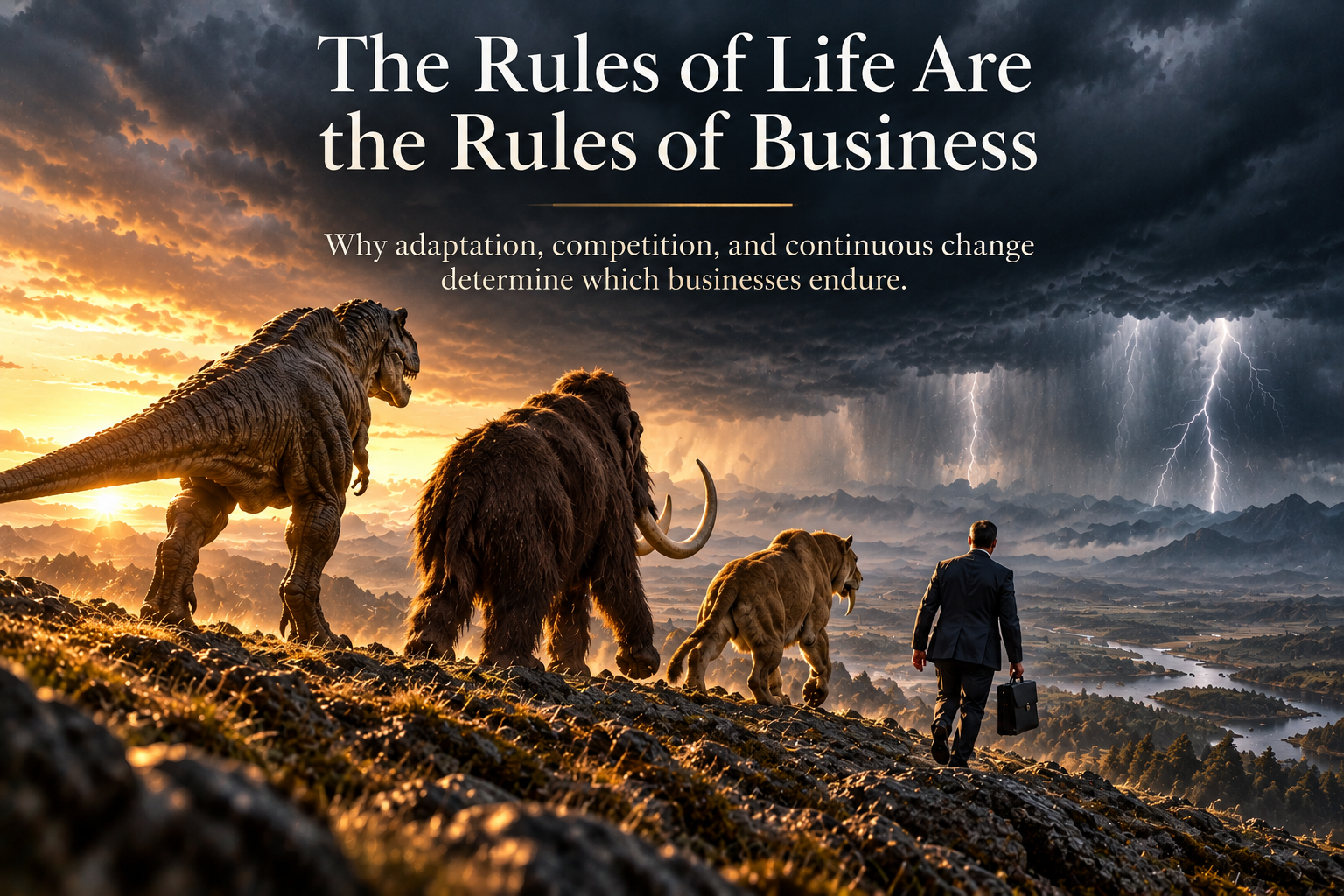
I recently watched the Netflix documentary Life on Our Planet. It describes billions of years of evolution through three remarkably simple rules:
1. Only the best adapted will win through.
2. Competition drives evolution.
3. Continuous change creates chaos.
What struck me wasn't how well these rules explain the natural world. It was how precisely they describe the business world.
Consider what's happening in professional services.
For decades, law firms, consulting firms, marketing agencies, and other advisory businesses have built their economics around access to specialized expertise and the people required to deliver it.
That model is being challenged in ways that would have seemed unimaginable just a few years ago.
And the three rules explain much of what's happening.
Rule 1: Only the best adapted will win through.
Notice the rule doesn't say the biggest, strongest, smartest, or most successful.
It says the best adapted.
Law firms aren't suddenly becoming less knowledgeable. But clients increasingly have access to tools that can draft agreements, analyze documents, and perform research that previously required substantial professional time.
The work hasn't disappeared. But the economics of delivering it are changing.
The firms that thrive may not be those with the most lawyers or the largest libraries of precedent. They may be those that rethink where human judgment creates value, how that judgment is delivered, and what clients should pay for it.
When growth stalls, the question isn't always how to sell more of what you do. Sometimes it's whether what you do is still what customers need to buy.
Rule 2: Competition drives evolution.
Competition doesn't always come from the competitor across the street.
Sometimes it comes from customers discovering they no longer need to buy what you sell.
Recently, I worked through an exercise developing a website, positioning, and brand messaging using AI. Work that historically might have required a $50,000 agency engagement took approximately six hours.
Was the result identical to what a talented agency could have produced? Perhaps not.
Was it sufficiently good to fundamentally change the buying decision? Absolutely.
That's the competitive threat.
Marketing agencies aren't simply competing against other agencies with better creative talent. They're increasingly competing against customers' ability to do portions of the work themselves.
And that changes everything about how services must be packaged, priced, and delivered.
Competition drives evolution, but the competitive threat doesn't always look like a competitor.
Rule 3: Continuous change creates chaos.
Now consider consulting and implementation firms.
Their clients are facing enormous uncertainty about AI, technology investment, organizational design, and the future of their operating models.
Many recognize that something fundamental is changing.
But they don't know what to do about it.
So they wait.
They postpone projects, delay investments, and choose the option that has quietly become one of the most formidable competitors in professional services:
Do nothing.
Meanwhile, the consulting firms themselves are confronting the same uncertainty.
Their traditional offerings may no longer address the questions clients are asking. Their delivery models may be too expensive. Their own people may not yet have the answers.
The organizations being paid to help businesses navigate change are themselves struggling to adapt to it.
That's chaos.
And it creates an interesting paradox: the need for sound advice may be increasing precisely when customers are becoming less willing to purchase traditional advisory services.
Three rules. Three business challenges.
Across industries, these dynamics tend to surface in three familiar situations.
When growth stalls: Is the company suffering from poor execution, or is its traditional value proposition becoming less relevant?
When the market shifts: Are we adapting to how customers now define value, or simply finding more efficient ways to deliver what they used to buy?
When M&A is needed—or isn't working: Are acquisitions bringing capabilities that improve our ability to compete, or simply adding scale and complexity to a business model that needs to evolve?
These questions matter especially in professional services, where acquisition strategies often focus on adding people, clients, geographic coverage, and specialized expertise.
Buying more of yesterday's business model doesn't necessarily create tomorrow's winning enterprise.
Sometimes the answer is an acquisition. Sometimes it's an entirely different commercial or operating model.
And sometimes the most important decision is recognizing what should be preserved.
The final lesson
Nature doesn't reward effort, good intentions, or historical achievement.
Neither do markets.
The organizations that endure aren't necessarily those that change the most. They're the ones that recognize what must change, preserve what shouldn't, and develop the capacity to do both.
The rules don't change. The businesses that survive do.