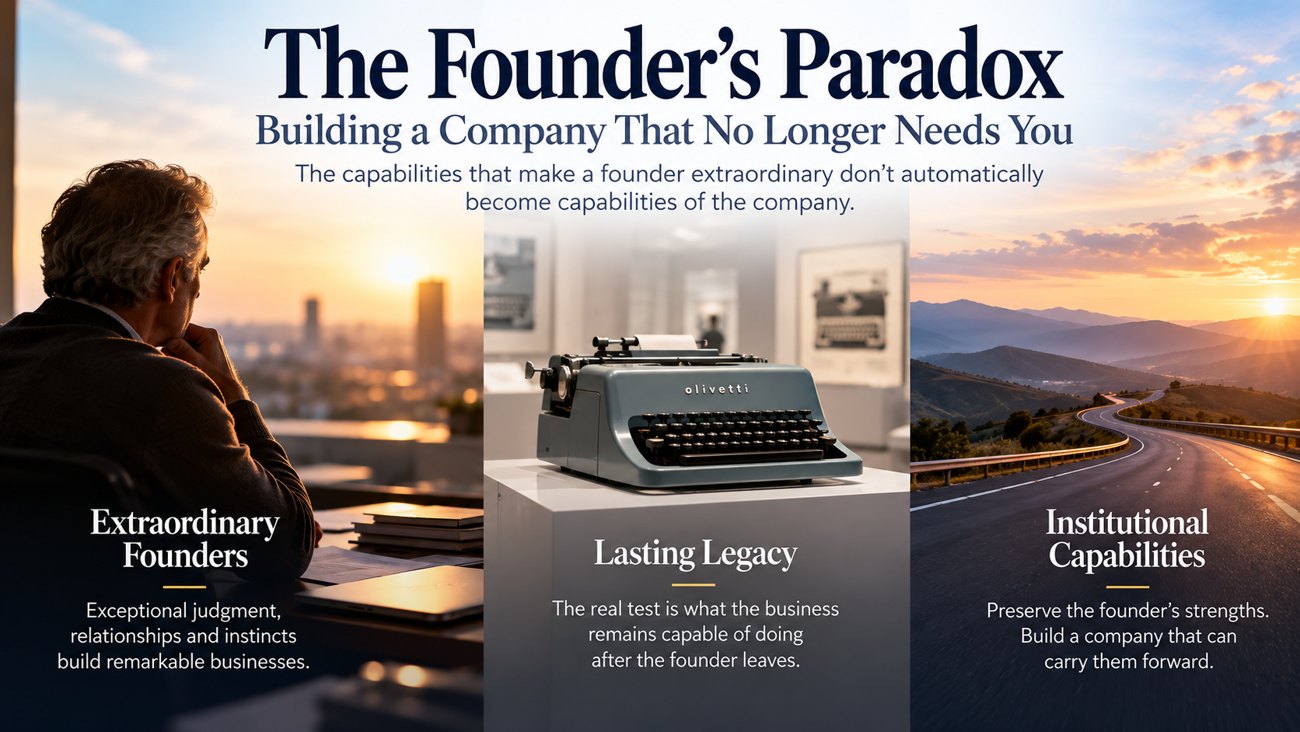
I've spent a significant part of my career working with founder-led businesses, both as an investor and as an operator. Some founders possess an extraordinary ability to understand their markets, anticipate customer needs, make commercial decisions, and inspire the people around them. They don't necessarily have sophisticated systems or elaborate processes.
They have something that can be considerably more valuable: judgment developed through years of experience.
They recognize opportunities others overlook. They understand their customers in ways that are difficult to explain, much less document. They develop relationships and make decisions that others struggle to replicate, and their businesses often become remarkably successful because of those abilities.
But I've increasingly come to believe that the very capabilities that make a founder extraordinary can eventually become the greatest constraint on the company's growth. Not because the founder has become less capable, but because the organization has not learned to do what the founder does instinctively.
There's Only One Kepler
What happens when the best salesperson in the company is also the person who doesn't believe the company needs a sales process?
I recently spent time with the founder of a successful business operating in a specialized market. I'll call him Kepler. Kepler is an exceptional salesperson. He knows how to identify the right decision-maker, gain access and build relationships. He anticipates objections before they arise and knows how to address them. He recognizes patterns in customer behavior and understands which opportunities are worth pursuing.
Much of this comes so naturally to him that he doesn't necessarily recognize how unusual his abilities are. His approach to selling is relatively straightforward: Get to the right decision-maker, establish credibility, convince the prospect to share the information necessary to evaluate the opportunity, and then let the company's technical experts demonstrate the value it can deliver.
For Kepler, that path works remarkably well, but the company has struggled to replicate that success with additional salespeople. Kepler has hired people, invested time in them, and become increasingly frustrated when they fail to produce comparable results. From his perspective, the job isn't particularly complicated. They simply need to get in front of the right people and obtain the information the company needs to demonstrate its value, but what Kepler considers straightforward is actually the product of years of accumulated knowledge, relationships, and pattern recognition.
He has confused what comes naturally to him with what should come naturally to everyone else.
Consider his perspective on an ideal customer profile. Kepler doesn't see much value in documenting one. He already knows who the best prospects are, and he's probably right, but the rest of the organization doesn't necessarily possess that knowledge.
The same is true of the sales process. Kepler knows how to navigate an organization, identify the economic buyer, anticipate objections, and establish credibility. He does not need a playbook to tell him how to do those things, but his salespeople do. Yet he is understandably resistant to documenting a process that, in his experience, works best when guided by judgment and relationships…and therein lies the challenge.
The founder doesn't need the playbook. The company does.
During one of our discussions, I made an observation: "There's only one Kepler. We can't duplicate you." The more important questions were what came next:
• What does Kepler know that we can teach other people?
• How does he identify the right decision-maker?
• What patterns does he recognize when evaluating an opportunity?
• How does he establish trust, handle objections, and decide when to walk away?
• What competencies must a salesperson possess to succeed in this particular business?
The objective isn't to create a rigid process that replaces Kepler's instincts. It's to understand the principles behind those instincts and make them accessible to other people.
The goal is not to create another Kepler. It's to build a commercial organization that can do more of what Kepler makes possible.
When the Founder Is the Operating Model
Some of the most valuable capabilities in a business don't appear on its balance sheet.
Kepler's situation is one version of a pattern I've encountered repeatedly. Another involves founders whose extraordinary personal relationships and judgment have become integral to how their businesses operate. Consider a composite of several founders I've worked with over the years.
These founders often possess an unusual combination of product intuition, commercial discipline, and an ability to build enduring relationships. They understand their markets at a level that would take most executives years to develop. They know which opportunities deserve investment, which relationships need attention, and when a seemingly unattractive short-term decision will create substantial long-term value.
They may negotiate aggressively with commercial partners while simultaneously understanding that the long-term health of those relationships matters more than maximizing the economics of any individual transaction. They also tend to inspire remarkable loyalty. Employees who have spent years building the business alongside the founder often develop a level of personal trust that transcends the formal organizational structure.
These are extraordinary advantages. They can produce exceptional economics, enduring customer relationships and a culture that competitors struggle to replicate, but as the business grows, the very concentration of those capabilities creates a different challenge: Important relationships may exist primarily through the founder, commercial decisions may depend on judgment that has never been articulated, employees may continue looking to the founder for decisions that should increasingly be made elsewhere in the organization, and personal loyalty, however admirable, can sometimes make it difficult to evaluate whether the capabilities that helped build the business are the same ones it needs for its next stage of development.
The founder's personal operating model has become the company's operating model.
This isn't necessarily a problem when the organization is small. In fact, it may be one of the reasons the company became successful, but as the business grows, the founder's personal capacity becomes an increasingly important constraint. The answer isn't to replace the founder's judgment with bureaucracy or eliminate the relationships that make the business special. It's to understand what makes those capabilities valuable and determine how they can become part of the organization.
• What principles guide the founder's commercial decisions?
• What makes certain relationships strategically important?
• How does the founder recognize an attractive opportunity?
• What values should inform decisions when the founder isn't in the room?
• And how do we preserve the culture while establishing the accountability required to operate at greater scale?
The objective is to preserve the founder's advantages while reducing the company's dependence on the founder.
That is a much more demanding task than simply introducing a new org chart.
Olivetti: When the Vision Outlives the Visionary
The ultimate test of institutionalization may come when the founder is no longer there.
There's a historical example that I've thought about for years, partly because of my personal connection to Piemonte, Italy. Adriano Olivetti built one of the most remarkable industrial enterprises of the twentieth century. Under his leadership, Olivetti became internationally recognized for its engineering, industrial design, innovative products, and distinctive philosophy of corporate responsibility, but Adriano wasn't simply building a successful typewriter company. He understood that electronics would fundamentally change the industry.
In 1959, Olivetti introduced the Elea 9003, a pioneering transistorized computer developed under the leadership of engineer Mario Tchou. The company possessed extraordinary technical capabilities and was positioning itself for a radically different technological future. Then, in February 1960, Adriano died unexpectedly. In November 1961, Mario Tchou died in a car accident. Within two years, the company had lost two pivotal figures behind its electronics strategy.
Adriano's son Roberto remained committed to electronics and assumed greater leadership responsibilities, but the company was also confronting substantial financial pressures, including the consequences of its acquisition of the American manufacturer Underwood.
In 1964, following the arrival of a new investor group, Olivetti transferred control of its electronics division to General Electric. The company continued to innovate, notably introducing the Programma 101 in 1965. But its opportunity to develop its pioneering position in large-scale computing had fundamentally changed.
Olivetti's history is far too complex to attribute to a single succession decision. Nevertheless, it raises a question that remains relevant to founder-led businesses today.
How much of the company's vision, strategic conviction and competitive advantage had become institutional, and how much still depended on the individuals who created it?
Adriano had built an extraordinary business, but the transition revealed how difficult it can be for an organization to sustain a founder's ambitions when pivotal leadership changes at a critical moment.
Institutionalize the Capabilities, Not the Preferences
The founders I've described illustrate different versions of the same challenge.
Kepler has extraordinary commercial instincts but struggles to understand why others cannot replicate them. Other founders possess exceptional product judgment, relationship-management capabilities, or operational instincts that have created tremendous enterprise value. None needs to become less exceptional, and none of their companies should discard the qualities that made them successful, but organizations need to distinguish between the founder's capabilities and the founder's personal preferences.
Kepler's ability to identify decision-makers and anticipate objections is a capability worth institutionalizing. His belief that documenting an ideal customer profile is unnecessary is a preference that may not serve the broader organization. A founder's ability to develop long-term commercial relationships is a capability worth institutionalizing. The expectation that every important relationship or decision must continue flowing through the founder is a preference that may become increasingly costly as the company grows.
The challenge is to preserve the founder's genius without perpetuating every habit that accompanies it.
This is where professionalization can go wrong. A new management team arrives and introduces the systems, processes and organizational structures that worked in other businesses. Some of those changes may be essential, but if management doesn't understand why the founder's original approach worked, it risks replacing a genuine competitive advantage with a more conventional, and potentially less effective, operating model. The objective isn't to make the company look like every other professionally managed business. It's to institutionalize the capabilities that make it different.
Succession Is Not Institutionalization
For PE investors, this challenge often becomes most visible during a change in ownership. The investment thesis may call for a professional CEO, a larger commercial organization, new management systems and an ambitious growth plan; all perfectly reasonable, but before designing the organization around the founder's departure, I think there are several questions worth understanding:
• What does the founder know that the organization doesn't? – Not simply which customers to call or which products to sell, but the underlying judgment that informs those decisions.
• Which capabilities can be taught? – Can the founder's customer knowledge become a repeatable approach to segmentation, qualification and account development? Can product instincts become a more systematic process for identifying unmet market needs? Can commercial judgment become a framework that allows others to make better decisions independently?
• Which capabilities should remain personal? – Some founders possess relationships, credibility or intuition that cannot be easily replicated. The organization may create more value by supporting those strengths than by attempting to replace them.
• What must the company become capable of doing without the founder? – This is ultimately the question that connects succession planning to value creation. A succession plan identifies who will occupy a role, but an institutionalization plan determines whether the organization can continue creating value when the person who defined that role is no longer there. They are not the same thing.
The Founder's Paradox
The most successful founders often create businesses that depend heavily on their own exceptional capabilities. Those capabilities may be the very reason the business is attractive to an investor. Yet the next stage of growth frequently requires the founder to distribute knowledge, delegate decisions, and build an organization that is less dependent on their personal involvement.
In other words, the founder must help the company become less dependent on the qualities that made the founder indispensable. That can be a difficult transition, and it requires considerable judgment from investors and incoming executives. If you move too slowly, the founder remains a bottleneck. If you move too aggressively and the organization may lose the very capabilities that made the investment attractive.
The objective isn't to eliminate founder dependence at any cost. It's to distinguish between dependence that creates value and dependence that constrains it. Then deliberately build the capabilities required for the business to succeed at its next stage of development.
What Does the Founder Leave Behind?
I think about Kepler, the many founders I've encountered over the years and Adriano Olivetti as different illustrations of the same fundamental challenge. One is an exceptional salesperson whose commercial judgment needs to become a more scalable organizational capability. Others have built extraordinary businesses through combinations of product intuition, commercial discipline, relationships and personal leadership, and Olivetti's history illustrates how difficult it can be to sustain an ambitious strategy when pivotal leadership disappears. None of these stories is simply about finding a replacement.
All raise a more important question about what becomes embedded in the organization. For founders, the next chapter of value creation may be less about personally driving every important outcome and more about developing the people, processes and capabilities that allow the business to accomplish things that were previously possible only through their involvement.
For PE investors, the opportunity is to recognize that the founder's knowledge and judgment may be among the most valuable assets being acquired, even when those assets don't appear on the balance sheet, and for incoming CEOs, the first priority shouldn't necessarily be changing how the business operates. It should be understanding why the business became successful in the first place.
A founder's legacy isn't simply the business they build. It's what the business remains capable of doing after they leave.